Why Decision Transparency Matters in Workflow Architecture
Decision Transparency matters in workflow architecture because decisions are what move work forward, and hidden decisions are what stop it. Every workflow contains approvals, routing choices, and judgment calls. When it's unclear where those decisions happen, who makes them, or what criteria they follow, work waits on the wrong people, outcomes vary by who is deciding, and the same questions get argued repeatedly. Decision Transparency makes a workflow's decisions visible, owned, and consistent.
Decision Transparency is the third of the Work Management Institute's seven Workflow Architecture Standards. Structural Clarity defines the workflow's stages. Explicit Handoffs defines how work moves between them. Decision Transparency defines the choices that determine where the work goes.
What Is Decision Transparency?
Important workflow decisions should be visible and intentional. Workflow architecture should define: where key decisions occur, who has authority to make them, what information informs the decision, and how the decision affects downstream work.
Put simply, a workflow has Decision Transparency when anyone involved can see where decisions happen, who makes them, and on what basis. Decisions aren't buried in someone's inbox, made differently depending on who is available, or known only to the people who have been around longest.
A transparent decision point can answer these questions:
Where does the decision occur? The specific point in the workflow where a choice is required.
Who has the authority to make it? A named role, not whoever happens to be asked.
What criteria apply? The rules, thresholds, or judgment standards that guide the choice.
What information is needed? What the decision-maker must have in order to decide without going back for more.
How is the outcome recorded? Where the decision and its reasoning are captured so the workflow, and later reviewers, can see them.
If the answer to any of these is "it depends who you ask," the decision isn't transparent.
For the full standard, including assessment criteria and common violations, see Decision Transparency on workflowarchitecture.com.
Why Hidden Decisions Break Workflows
Decisions shape a workflow more than any task does. A task takes time, but a decision determines whether work moves forward, gets sent back, takes a different path, or stops. When decision points aren't designed, the workflow's real behavior is set by whoever makes each call, in whatever way they make it.
Workflows without Decision Transparency fail in recognizable ways:
Invisible decisions. Choices that shape the work are made informally, so nobody downstream knows why work arrived the way it did.
Bottleneck deciders. Decisions default to one senior person because authority was never delegated, and work queues behind their calendar.
Inconsistent outcomes. The same request gets approved by one person and rejected by another because the criteria live in people's heads.
Relitigated decisions. Without recorded reasoning, settled questions get reopened whenever a new participant joins or a stakeholder disagrees.
Approval sprawl. Approvals added in response to past problems pile up, and the reason for each is forgotten long after it stopped being useful.
These patterns build up as decision debt: unresolved or undesigned decisions that slow everything downstream. A common form is approval debt, where approval gates queue work, pile up as sediment, become rubber stamps, or sit with the wrong person.
How Decision Transparency Connects to the Other Standards
It depends on Structural Clarity. Decision points can only be placed once the workflow's stages are defined.
It depends on Explicit Handoffs. Many decisions travel with a handoff, such as an approval before work moves on or a routing choice about who receives it. An implicit handoff usually hides a decision too.
It enables Flow Efficiency. Waiting for decisions is one of the largest sources of delay. Once decision points are visible, the wait time around them can be measured and reduced.
It enables Exception Readiness. An exception is a situation the standard decision rules don't cover. You can't design for exceptions until the standard rules are clear.
It enables Measurable Performance. Transparent decisions produce measurable signals, such as approval wait times and rejection rates, that show whether decision points are working.
Decision Transparency and Scale
In a small team, decisions are often made by whoever knows best, and everyone can see them happen. As a workflow grows, decisions spread across more people, teams, and systems. Without transparency, decision-making either centralizes in a few overloaded people or fragments into inconsistent local practice.
Neither scales. Centralized decisions turn leaders into bottlenecks. Fragmented decisions produce outcomes that vary by team, region, or individual. Decision Transparency lets decisions be delegated safely, because the criteria travel with the authority. For more on why growth exposes these gaps, see Designing Workflows for Scale Requires Workflow Architecture.
Decision Transparency in the Age of AI
AI agents make decisions constantly: classifying requests, routing work, choosing what to draft, deciding when something is complete. Each is a decision point inside the workflow, whether or not anyone designed it as one.
Without Decision Transparency, organizations can't answer basic governance questions. Which decisions has an agent been allowed to make? Which must go to a human? What criteria is the agent applying, and are they the same criteria a person would use? When an outcome is wrong, where was the decision made and why?
This is why Decision Transparency underpins AI Workflow Governance. Explicit Delegation requires defining which decisions an agent may make on its own. Drift Detection requires knowing what an agent's decisions should look like, so you can tell when they change. It also reflects the principle of Humanity Over Tools: decisions that need human judgment should be designed to stay with people, not handed to a system by default. See Agentic Workflow Architecture™ for how decision authority is designed across human and agent participants.
How Decision Transparency Connects to Work Management
Decision rules are one of the core components of any work system. They govern how work is evaluated, routed, and approved. Decision Transparency is how those rules are designed into a workflow instead of being left to habit.
It also connects to ownership. The IDEAS Workflow Ownership Model defines five ownership domains: Intent, Design, Execution, Alignment, and Signal. That structure lets decision authority be assigned deliberately rather than defaulting to seniority or availability.
How to Assess Decision Transparency
Start by testing a single workflow:
Map every decision point. Using the stages from Structural Clarity, mark each place where a choice determines what happens next: approvals, routing, prioritization, acceptance, rejection.
Check each one against the five questions. Where it occurs, who decides, what criteria apply, what information is needed, and how the outcome is recorded.
Test for consistency. Give the same scenario to two people with the same decision authority. If they reach different outcomes, the criteria aren't transparent.
Audit the approval gates. For each approval, check its rejection rate and average wait time. A gate that almost never rejects but always delays may be a rubber stamp worth removing.
Document and publish decision rules. Record authority, criteria, and required inputs for each decision point where participants can reference them.
A workflow has Decision Transparency when every decision point is visible, every decision has a clear owner and criteria, and the same situation produces the same outcome no matter who handles it.
Frequently Asked Questions
What is Decision Transparency in workflow architecture?
Decision Transparency is the third of the seven Workflow Architecture Standards defined by the Work Management Institute. It requires a workflow's decision points, including who decides, what criteria apply, and how outcomes are recorded, to be explicit and visible rather than informal or hidden.
Why do decisions slow workflows down?
Work often waits longer for decisions than for tasks. When decision authority is unclear or concentrated in a few people, work queues behind them. When criteria are unclear, decisions get revisited, reversed, or escalated, adding more delay.
Does Decision Transparency mean every decision needs approval?
No. Decision Transparency often reduces approvals. Once criteria are clear, decisions can be delegated to the people closest to the work, and approvals that exist only because of unclear rules can be removed.
How does Decision Transparency apply to AI agents?
AI agents make decisions within workflows, such as routing, classifying, and determining completion. Decision Transparency requires those decisions to be designed explicitly: which ones an agent may make, what criteria it applies, and which must go to a human.
What is the difference between decision debt and approval debt?
Decision debt is the accumulated cost of unresolved or undesigned decisions across a workflow or organization. Approval debt is a specific form, focused on approval gates that queue work, outlive their purpose, turn into rubber stamps, or sit with the wrong person.
Decisions Are the Workflow's Steering
Stages give a workflow its shape and handoffs keep it moving, but decisions determine where it actually goes. When decisions are hidden, the workflow is steered by habit, availability, and whoever speaks loudest. Decision Transparency puts steering into the design, where it can be seen, delegated, and improved.
Previous in the series: Why Explicit Handoffs Matter in Workflow Architecture
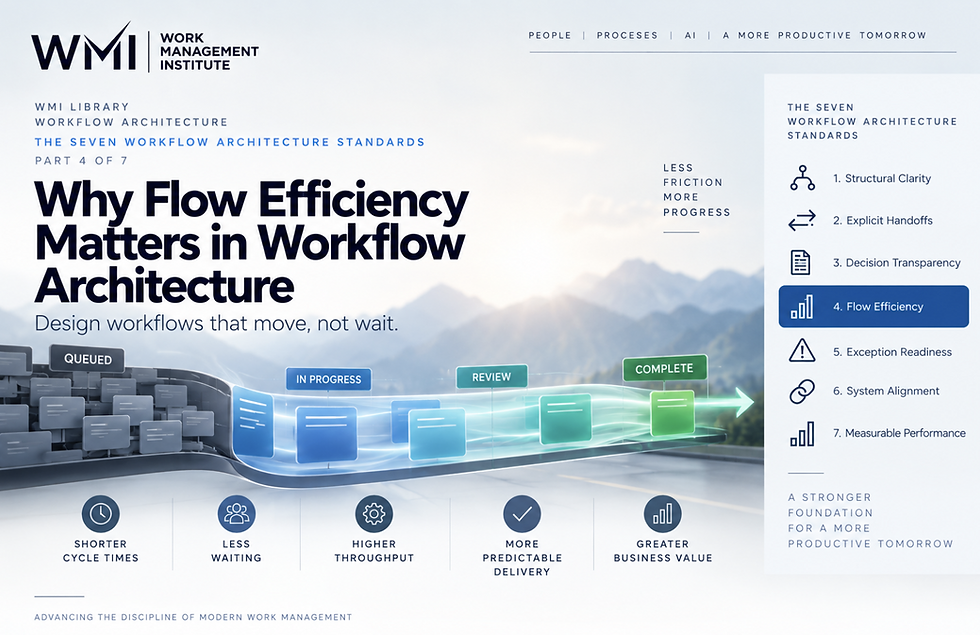
Next in the series: Why Flow Efficiency Matters in Workflow Architecture
Interested in becoming a Certified Workflow Architect™? Join the CWA waitlist →