

Work Value Pyramid™
Developed and authored by Brandon Hatton. Exclusively licensed to and formalized by the Work Management Institute.
Official Framework Overview
The Work Value Pyramid™ is a foundational Work Management framework that explains how value is created through work—and why not all work produces the same level of impact.
The framework organizes work into progressive levels, helping individuals, teams, and organizations distinguish between activity, progress, and outcomes. By making value explicit, the Work Value Pyramid™ enables better prioritization, clearer decision-making, and more intentional execution.
The framework is designed to be universal, practical, and easy to apply across roles, functions, and industries.
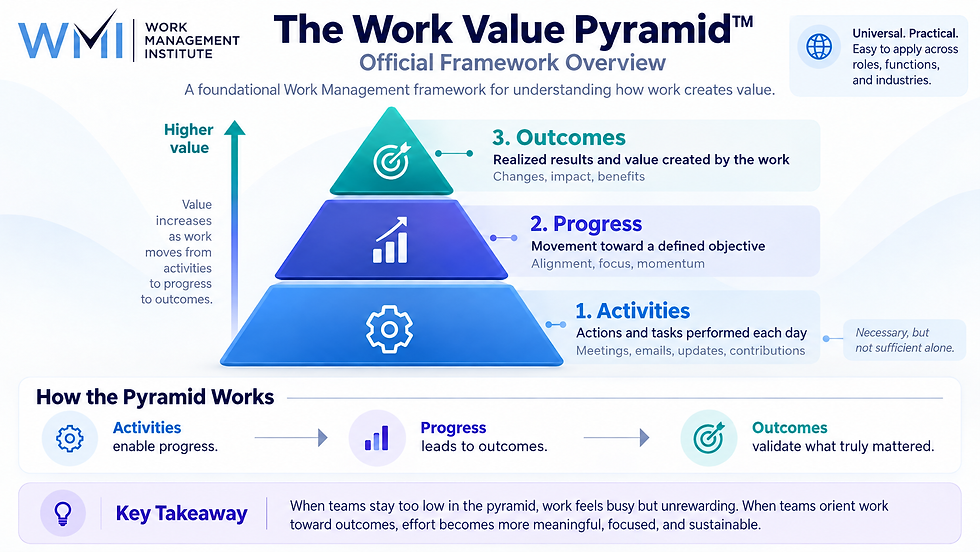
The Three Levels of the Work Value Pyramid™
Level 1: Activities
Activities represent the actions and tasks people perform each day. They are the visible motions of work—meetings, emails, updates, and individual contributions.
While activities are necessary, activity alone does not guarantee value. Without direction, teams can remain busy without making meaningful progress.
Level 2: Progress
Progress reflects movement toward a defined objective. It connects activities to intent, showing that effort is advancing work forward rather than simply consuming time.
Progress introduces alignment, focus, and momentum. It answers the question: Are we moving closer to what matters?
Level 3: Outcomes
Outcomes represent the realized results and value created by work. They are the changes, impacts, or benefits that justify the effort invested.
Outcomes anchor work to purpose. They ensure that teams are not only progressing—but delivering something that matters.
How the Pyramid Works
The Work Value Pyramid™ illustrates that higher-value work builds on lower levels:
-
Activities enable progress
-
Progress leads to outcomes
-
Outcomes validate which activities and progress truly mattered
When teams operate too low in the pyramid, work feels busy but unrewarding. When teams orient work toward outcomes, effort becomes more meaningful, focused, and sustainable.
The Work Value Pyramid™ serves as a core evaluative model within the Work Management discipline. It provides a shared lens for assessing work, prioritizing initiatives, and aligning execution with organizational value.
The framework underpins multiple Work Management Institute assets, including:
-
The Work Management Body of Knowledge (WMBOK™)
-
Certified Associate in Work Management (CAWM™)
-
Work Management Professional (WMP™)
Role Within the Work Management Discipline
Framework Governance
The Work Value Pyramid™ is governed, maintained, and evolved by the Work Management Institute as part of its foundational framework portfolio.
WMI is responsible for:
-
Maintaining the official definitions and structure of the framework
-
Ensuring alignment with the Work Management Body of Knowledge
-
Managing updates, interpretations, and educational use
-
Protecting the integrity and consistency of the framework
Canonical Framework Definition
The Work Value Pyramid™ is a foundational framework of the Work Management Institute. It organizes work into three levels—Activities, Progress, and Outcomes—providing a shared model for understanding how effort becomes value.
Usage and Citation
The Work Value Pyramid™ may be referenced for educational and explanatory purposes with appropriate attribution.
Preferred citation:
Work Value Pyramid™ — Developed by Brandon Hatton; formalized and stewarded by the Work Management Institute.
Commercial use, certification alignment, or derivative frameworks require authorization from the Work Management Institute.
© Work Management Institute. All rights reserved.